English
- English
- Español
- Português
- русский
- Français
- 日本語
- Deutsch
- tiếng Việt
- Italiano
- Nederlands
- ภาษาไทย
- Polski
- 한국어
- Svenska
- magyar
- Malay
- বাংলা ভাষার
- Dansk
- Suomi
- हिन्दी
- Pilipino
- Türkçe
- Gaeilge
- العربية
- Indonesia
- Norsk
- تمل
- český
- ελληνικά
- український
- Javanese
- فارسی
- தமிழ்
- తెలుగు
- नेपाली
- Burmese
- български
- ລາວ
- Latine
- Қазақша
- Euskal
- Azərbaycan
- Slovenský jazyk
- Македонски
- Lietuvos
- Eesti Keel
- Română
- Slovenski
- मराठी
- Srpski језик

How Does an Automatic Drawer Box Making Machine Improve Efficiency?
An automatic drawer box making machine improves production efficiency by combining multiple manufacturing steps, reducing manual handling, and shortening changeover time. Rongda's RB350S dual-station system can produce 30–66 boxes per minute, depending on box size and configuration. With fully servo-controlled operation, robotic positioning, and a high-precision camera system, it helps packaging manufacturers improve output consistency while handling different box specifications.
Table of Contents
- How Does an Automatic Drawer Box Making Machine Improve Efficiency?
- Why Does Dual-Station Production Make a Difference?
- How Do Servo Control and Automatic Positioning Reduce Downtime?
- Which Production Steps Can One Machine Complete?
- RB350S Technical Specifications
- Where Is an Automatic Drawer Box Making Machine Used?
- What Should Manufacturers Consider When Choosing a Machine?
- Frequently Asked Questions
How Does an Automatic Drawer Box Making Machine Improve Efficiency?
In rigid box manufacturing, production efficiency is not determined by machine speed alone. Material feeding, gluing, cardboard forming, corner pasting, positioning, and box wrapping all affect the time required to complete a finished box. When these operations rely on separate machines or manual handling, the production line can lose time between processes.
We see this particularly in factories producing drawer boxes, jewelry boxes, cosmetic packaging, and other premium rigid packaging. Different box dimensions, frequent order changes, and requirements for consistent appearance can make manual production difficult to manage at higher volumes.
An Automatic Drawer Box Making Machine addresses these challenges by integrating several operations into one production system. Instead of transferring semi-finished products between multiple workstations, the machine coordinates feeding, forming, positioning, and wrapping within an automated workflow.
At Rongda, our RB350S dual-station automatic drawer box making machine is designed around this production requirement. It reaches a working speed of 30–66 pcs/min, depending on box size and machine configuration. For manufacturers handling different box specifications, this combination of integrated processing and automated control can help reduce unnecessary production interruptions.
Why Does Dual-Station Production Make a Difference?
One of the main differences between the RB350S and a traditional single-station system is its dual-station configuration. Both stations can operate simultaneously, allowing two different box types to be processed within one production cycle.
In practical production, this design is useful when a factory handles multiple packaging orders or needs to manufacture different box specifications. A single-station machine processes one production task at a time, while a dual-station system provides more flexibility in organizing the workflow.
For example, a packaging manufacturer producing jewelry boxes and cosmetic boxes may need to handle different dimensions and paper designs within the same production schedule. The RB350S can support two different product types through its dual-station design, reducing the need to treat every production task as a completely separate operation.
The actual output still depends on box dimensions, materials, and machine settings. However, simultaneous station operation provides a practical advantage for factories looking to improve equipment utilization without relying entirely on additional machines.
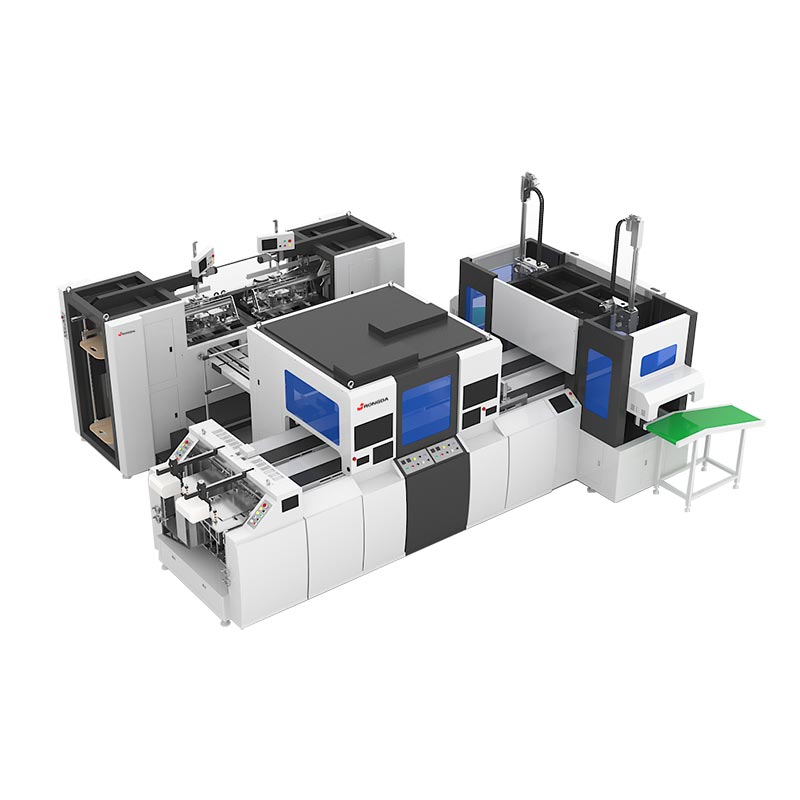
Single-Station and Dual-Station Production Compared
| Comparison | Traditional Single-Station System | Rongda RB350S Dual-Station System |
|---|---|---|
| Station configuration | One production station | Two simultaneous production stations |
| Product handling | One box type processed per production task | Two different box types can be processed simultaneously |
| Production speed | Depends on machine model and configuration | 30–66 pcs/min |
| Changeover | May require more manual adjustment | Fully servo control supports rapid parameter adjustment |
| Suitable production | More straightforward single-product runs | Multiple box specifications and higher-output production |
How Do Servo Control and Automatic Positioning Reduce Downtime?
Production speed can drop significantly when operators need to stop equipment for repeated manual adjustments. This is especially noticeable when changing box dimensions or switching between packaging orders.
The RB350S uses a fully servo-controlled system to support rapid parameter adjustments. This makes it easier to adapt the machine to different box specifications and reduces dependence on repeated manual positioning. Its quick mold-change capability is another important feature for manufacturers handling varied production orders.
We also integrate a high-speed motion controller, a robot, and a high-precision camera positioning system. These components work together to coordinate material movement and box positioning during production.
Three Features That Support More Stable Production
- Fully servo control: Supports accurate movement control and faster parameter adjustments when changing production specifications.
- Robotic positioning: Coordinates automated handling and positioning, reducing the amount of manual intervention required.
- High-precision camera system: Helps identify positioning references so that box components can be aligned during the production process.
The machine also features an intuitive HMI, allowing operators to manage production settings through a centralized interface. In our experience, convenient parameter management is important because a high-speed machine is only useful when operators can set up and monitor it efficiently.
Which Production Steps Can One Machine Complete?
Another factor affecting manufacturing efficiency is the number of separate operations required to complete a finished rigid box. When each stage is handled by different equipment, semi-finished materials must be transferred, positioned, and checked repeatedly.
The RB350S integrates several key processes into one automated production cycle. These include:
- Paper feeding and gluing: Paper is fed into the system and prepared for the wrapping process.
- Cardboard conveying: Cardboard components are automatically transferred to the forming section.
- Box forming: The cardboard is shaped according to the required box dimensions.
- Four-corner pasting: The machine completes corner pasting to secure the box structure.
- Positioning: The robot and camera positioning system coordinate the placement of box components.
- Box wrapping: Paper is wrapped around the formed cardboard structure to complete the rigid box.
Integrating these operations helps reduce intermediate handling and makes the production workflow more continuous. For manufacturers producing premium packaging, it also provides a more controlled process for managing box appearance and assembly consistency.
For factories building a complete post-press production line, Rongda also provides equipment covering rigid box making, case making, laminating, UV coating, hot stamping, embossing, die-cutting, and other packaging processes.
What Are the Technical Specifications of the RB350S?
Before selecting an automatic drawer box making machine, manufacturers should check whether its working range matches their regular box dimensions, paper thickness, and cardboard specifications. The following parameters describe the Rongda RB350S model.
| Parameter | RB350S Specification |
|---|---|
| Model | RB350S |
| Minimum Box Size | 40 × 60 mm |
| Maximum Box Size | 270 × 350 mm |
| Paper Size | 70 × 110 mm to 460 × 600 mm |
| Box Height | 12–120 mm |
| Inner Fold Size | 10 × 100 mm |
| Folded Ear Size | 10 × 100 mm |
| Paper Thickness | 100–300 g/m² |
| Board Thickness | 0.8–3 mm |
| Production Speed | 30–66 pcs/min |
| Motor Power | 30 kW |
| Electric Heating Power | 10 kW |
| Air Source Requirement | 50 L/min, 0.6 MPa |
| Machine Weight | 8,000 kg |
| Machine Dimensions | 6,800 × 6,200 × 3,260 mm |
| Certification | CE |
These specifications are useful when checking whether the equipment can accommodate existing packaging designs. For example, the 40 × 60 mm to 270 × 350 mm box-size range covers various compact and medium-sized rigid box applications. The 12–120 mm box-height range also provides flexibility for different packaging structures.
However, maximum machine speed should not be treated as the guaranteed output for every product. Box dimensions, paper properties, board thickness, and production settings all influence actual running speed. We recommend confirming the intended box samples and materials before finalizing a machine configuration.
Where Is an Automatic Drawer Box Making Machine Used?
Automatic rigid box production is particularly relevant to industries where packaging structure, surface appearance, and assembly consistency affect the perceived value of the finished product.
Based on the RB350S production range and its intended applications, the machine is suitable for manufacturing high-end rigid boxes used in several sectors.
- Jewelry packaging: Rigid boxes for rings, necklaces, bracelets, and other premium accessories.
- Cosmetics and perfume: Presentation boxes for skincare products, fragrance bottles, and gift sets.
- Electronics: Protective and presentation packaging for selected electronic products and accessories.
- Tea and alcohol packaging: Premium gift boxes that require a rigid structure and carefully wrapped exterior.
- Stationery: Presentation boxes and storage packaging for premium stationery products.
- Footwear, apparel, and luxury goods: Rigid packaging for branded products and gift collections.
For manufacturers supplying multiple industries, having an automatic rigid box making machine with an adjustable production range can make equipment utilization more flexible. The key is to match the machine's working dimensions with the actual box designs required by the production schedule.
What Should Manufacturers Consider When Choosing an Automatic Drawer Box Making Machine?
We recommend evaluating a machine based on actual production requirements rather than focusing only on its advertised maximum speed. Several factors deserve attention before making an equipment investment.
1. Box Dimensions and Material Compatibility
Check the minimum and maximum box dimensions, box height, paper weight, and cardboard thickness. A machine should accommodate the specifications of your regular orders, not just one sample box.
2. Production Speed and Station Configuration
Ask whether the stated output refers to a specific box size or a general operating range. If your factory handles different box types, a dual-station system may offer more flexibility than a single-station configuration.
3. Changeover and Parameter Adjustment
Frequent order changes can reduce effective production time. Servo-controlled adjustment and quick mold changing are worth considering if your factory produces multiple packaging specifications.
4. Positioning Accuracy and Machine Stability
Robotic handling, camera positioning, and a stable machine frame all contribute to the production process. The RB350S uses a high-strength casting frame to maintain stability during high-speed operation.
5. Technical Support and After-Sales Service
Installation guidance, operator training, troubleshooting, and spare-parts support should also be considered. Rongda provides a one-year warranty and lifetime technical support for the RB350S, helping customers maintain the equipment after installation.
Frequently Asked Questions
1. What is an automatic drawer box making machine?
An automatic drawer box making machine is packaging equipment designed to automate the production of rigid boxes. Depending on its configuration, it can integrate paper feeding, gluing, cardboard forming, corner pasting, positioning, and box wrapping into one production workflow.
2. What is the production speed of the Rongda RB350S?
The RB350S has a production speed of 30–66 pcs/min. Actual output depends on box dimensions, materials, and machine configuration.
3. What is the advantage of a dual-station box making machine?
A dual-station system allows two stations to operate simultaneously and process two different box types in one production cycle. This can improve equipment utilization and provide more flexibility for factories handling multiple packaging orders.
4. What materials can the RB350S process?
The RB350S supports paper thicknesses of 100–300 g/m² and cardboard thicknesses of 0.8–3 mm. Its box-size range is 40 × 60 mm to 270 × 350 mm, with a box height of 12–120 mm.
5. How does servo control improve production efficiency?
Servo control supports accurate machine movements and rapid parameter adjustments. On the RB350S, it works with the automatic positioning system and quick mold-change design to make specification changes more convenient.
6. What products can the RB350S manufacture?
The machine is designed for high-end rigid box applications, including jewelry, cosmetics, perfume, electronics, tea, alcohol, stationery, footwear, apparel, and luxury goods packaging.
7. What after-sales support does Rongda provide?
Rongda provides a one-year warranty and lifetime technical support for the RB350S. The machine is also CE certified.
Improve Your Rigid Box Production with Rongda
Improving rigid box manufacturing efficiency requires more than increasing machine speed. A well-designed production system should coordinate feeding, forming, positioning, and wrapping while allowing operators to manage different box specifications with less downtime.
With its dual-station configuration, 30–66 pcs/min production speed, fully servo-controlled operation, robotic positioning, and high-precision camera system, Rongda's RB350S provides an integrated solution for manufacturers producing premium rigid boxes.
Since 2021, Wenzhou Rongda Packaging Equipment Co., Ltd. has supplied post-press packaging equipment to customers in more than 60 countries and regions. Our product range covers rigid box production, case making, printing, laminating, UV coating, hot stamping, embossing, die-cutting, gluing, and related packaging processes.
If you are planning to upgrade your rigid box production line, visit our Automatic Drawer Box Making Machine product page to learn more about the RB350S. You can also explore our complete packaging production equipment range or contact Rongda with your box dimensions, material specifications, and production requirements.
Next:
-
Related News
- How Does an Automatic Drawer Box Making Machine Improve Production?
- How Edge Gluing and Pressing Technology Is Transforming Rigid Box Manufacturing
- How Does an Edge Gluing and Pressing Machine Improve Box Making?
- Can an Integrated Case Making Machine Improve Cover Production Efficiency?
- Why Is Precise Edge Folding Essential for Premium Rigid Box Production?
- How Is a Book-Shaped Rigid Box Made? A Complete Guide to the Manufacturing Process and Automation
Leave me a message


News Recommendations